

When One is too many because a Thousand is never enough.
Therapy for Recovery from Addiction, Substance use and Dependence
If you feel caught in a constant tug-of-war between the version of yourself that is desperate for change and the part that feels paralyzed by the thought of letting go, please know you are not alone.
Recovery is not just about stopping a behavior. It is about recalibrating a nervous system that learned to survive through escape. Your past has taught you that certain patterns were necessary to cope with pain, creating an automatic cycle where a trigger leads to a craving, which dictates an action. While those patterns once provided a sense of relief or safety, they have become rigid. What was once a life raft has become an anchor. At Emotive Wellness, you no longer have to navigate the weight of "what now" or the exhaustion of attempting to hold it all together by yourself.
Because there is a difference between enduring your life and inhabiting it
Stepping into Emotive Wellness means we stop running, avoiding and distracting from areas that isolate use from Hope. We want to identify the foundation of what has brought you to this moment and begin to see a future where it’s not about enduring but striving.
If for instance you
1. The Need for an External Reset
You find yourself using a substance or behavior as a forced reset button to regulate your internal state. If you feel you cannot shift from stress to calm, or from numbness to feeling, without this specific external fix, it is a sign that your nervous system is no longer self regulating.
2. Diminishing Returns and Increased Intensity
The original amount of the substance or the frequency of the behavior no longer provides the same emotional relief. You find yourself needing more intensity just to achieve a sense of ease or to simply feel normal. This is the brain physically adapting to the pattern and demanding more to reach the same baseline.
3. Retreating into Avoidance
The behavior becomes a way to outrun the struggle rather than address it. You may notice yourself retreating from responsibilities, honest conversations, or your own goals because the addictive pattern has become your primary shield against discomfort or pressure.

4. The Hijacking of Agency
Even when you have a strong conviction to stop or cut back, you find the impulse bypasses your logic. This happens because the survival center of the brain has taken over the decision making process, prioritizing the addictive loop over your long term values and your power of choice.
5. Internal Friction and Isolation
The pattern creates a gap between the life you are performing for the world and the life you are actually feeling. This secrecy leads to a deep sense of isolation where you feel disconnected from others and from the hope that you can live without the behavior. You are no longer inhabiting your life; you are managing a cycle.

The weight of your recovery, the history of these addictive behaviors and how they have manifested, or the constant effort required to stay sober might feel like they define your entire existence lately. None of those things touch the core of who you are, though; you are so much more than a history of addiction or a set of milestones.
You walk with such deliberate resolve toward repairing what was broken, striving to be the reliable spouse, the present parent, the stable provider, or the friend who finally showed up. But what would it look like if you walked with that same purpose toward the person underneath the sobriety, the one who exists outside of the cravings, the amends, and the daily work of staying clean?
The goal is not to abandon your responsibilities or the progress you have made, but to reconnect with the part of you that makes those roles and that healing possible in the first place. It is about finding that small, quiet space where you are no longer twisted up in the fear of a potential relapse or the pressure of a perfect outcome, and instead finding a little bit of space to simply be, to be unbound, and to be enough.

Addiction and it’s Many Forms
The cycle of addiction isn't always a visible loss of control. For many, it is a strategic attempt to manage a life that has become too heavy to carry. It can look like a drive for perfection, an inability to say no, or a quiet withdrawal from the people you love.
Substance Use (Chemical Addiction)
Alcohol: A central nervous system depressant often used to induce relaxation, lower inhibitions, or numb emotional and physical distress.
Opioids and Pain Medications: (Heroin, Fentanyl, Oxycontin) These bind to the body's opioid receptors, creating a powerful sense of euphoria and complete detachment from pain.
Stimulants: (Cocaine, Methamphetamine, ADHD medications) These accelerate the body's systems, providing a surge of energy, alertness, and artificial confidence.
Sedatives and Anxiolytics: (Benzodiazepines, Sleeping pills) Used to forcibly quiet the nervous system, often resulting in a "blackout" or a total suppression of anxiety.
Cannabis: Used to alter sensory perception and induce a state of calm, though it can also lead to amotivational states or increased paranoia over time.
Behavioral (Process Addictions)
Gambling: Driven by the "intermittent reinforcement" of a potential win, creating a high-stakes adrenaline loop that becomes more important than the money itself.
Sexual Compulsivity: The use of sexual thoughts or behaviors as an emotional regulator to "shock" the system out of numbness or provide an intense, fleeting escape.
Eating Disorders and Food Addiction: Using the consumption (or restriction) of food to exert control over internal chaos or to provide a temporary "doping" effect to the brain.
Compulsive Spending: The "acquisition high" where the act of buying provides a momentary sense of power, status, or a "reset" from a low mood.
Relationship and Love Addiction: A cycle of seeking the "infatuation high" to avoid facing internal voids or the reality of one's own company.
Cycle of Addiction
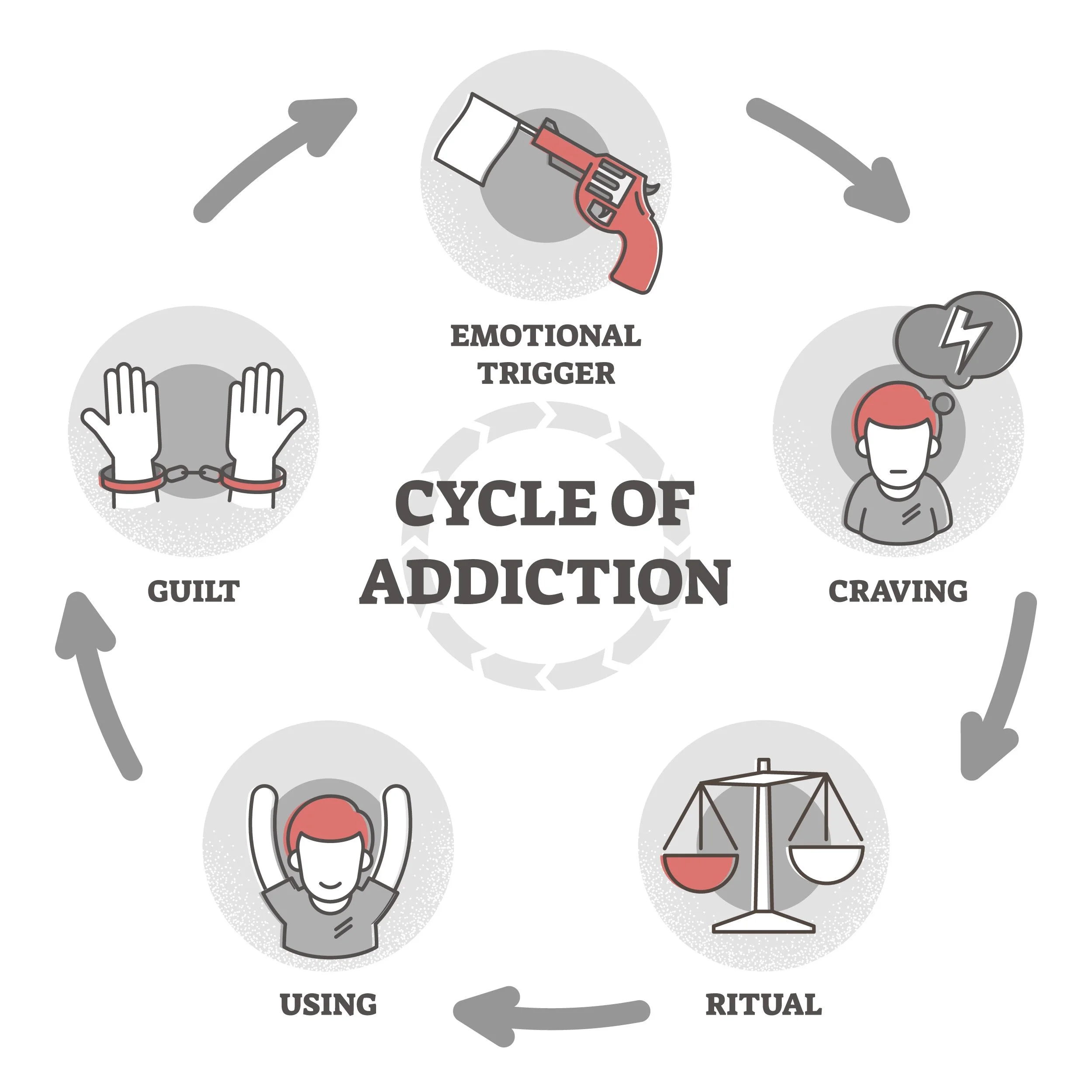
The cycle of addiction is a self-perpetuating loop that begins with a trigger, an internal emotion or external situation that the nervous system perceives as unmanageable. This pressure immediately manifests as a craving, which is an intense physical or mental urge that promises relief from the rising tension. To bridge the gap between distress and escape, the individual enters a ritual, a set of familiar behaviors or obsessive planning that heightens anticipation and narrows the focus until it culminates in usage. While the act provides a fleeting moment of peace or intensity, it is rapidly followed by a shame crash of profound guilt. This distress does not resolve the original problem; instead, it adds a new layer of internal pain, effectively becoming the next trigger that restarts the entire cycle.
Exchange the exhaustion of avoidance for the clarity of conviction.

“My goal is to identify what you are avoiding in the present and how your past informed that pattern. While what you are facing feels overwhelming, let’s uncover what keeps you retreating and depending on external fixes instead of your most stable force of validation: you. We will discover confidence is not how well we do something, but how well we know who we are beyond pressure, roles, and external qualifiers of success.”
FAQs
-
Yes. Addiction is a treatable condition, and recovery is a process of reclaiming the parts of yourself that have been overshadowed by a cycle of escape. Because addiction is fundamentally a physiological and emotional attempt to regulate a distressed nervous system, treatment involves more than just willpower. It requires a strategic approach to rebalancing how your brain and body respond to pressure.
Recovery is not just about the absence of a behavior; it is about the presence of new, sustainable ways to live. By identifying the architecture of your patterns and the roots of your triggers, you can move from a state of constant survival to a state of internal ease.
-
Addiction rarely begins as a desire for self destruction. Instead, it often starts as a functional solution to an internal problem. Whether the source is a history of trauma, the weight of daily stress, or a numbed nervous system, the brain discovers that a specific substance or behavior provides a high intensity emotional reset. How this pattern evolves into a struggle is a complex interplay of genetics, biology, and the choices we make while searching for relief. Some individuals have a genetic predisposition that makes their nervous system more sensitive to stress, meaning that first experience of an external reset can feel like finally finding a missing piece of a puzzle.
Over time, what began as a temporary escape evolves into a physiological requirement as the brain undergoes physical and chemical changes. This is where the disease model takes hold. The brain’s reward system is hijacked, and the nervous system begins to prioritize the reset button over natural sources of satisfaction, eventually viewing the behavior as a requirement for survival. While addiction can bypass the part of the brain responsible for logic and make it feel as though the power of choice is gone, recovery is the process of reclaiming that agency. By recognizing that addiction is a learned survival strategy influenced by your biology, you can begin the work of unlearning it and moving toward a life of genuine internal ease and conviction.
-
Treating addiction is about moving from a state of survival to a state of internal peace. It is not just about stopping a behavior but about building a life where you no longer feel the need to escape. Instead of using a forced reset button like a substance or a behavior to get through the day, the goal of treatment is to help your body and mind learn how to feel steady on their own.
We start by looking at what keeps you retreating and depending on things outside of yourself. Through comfortable, open conversation, we move away from what society expects of you and focus on what you actually want for your life. We also use tools like EMDR to unlock old, stressful memories that might be keeping you stuck. This helps your brain finally file those past events away so they don't keep triggering you today. As you heal, you will discover that true confidence comes from knowing who you are, rather than how well you perform for others.
-
Recovery looks like moving from a life of constant defense to a life of genuine presence. It is the transition from outrunning your struggle to standing firmly in your own conviction. While many people think recovery is just the absence of a substance or behavior, it is actually the presence of a new, stable foundation within yourself.
In a life of recovery, you no longer feel the need to use a forced reset button to survive the day. Instead, you inhabit a calibrated nervous system that allows you to handle pressure without retreating. You begin to experience a sense of ease that doesn’t require an external fix, and you find that your most stable force of validation comes from who you are rather than what you do.
Ultimately, recovery looks like the freedom to be yourself. It is the discovery that confidence isn't a performance for the world, but the quiet strength of knowing your own heart. You move away from the safety of avoidance and toward the clarity of your own voice, finally inhabiting the life you have worked so hard to build.
How Therapy Works at Emotive Wellness
Our Approach
Understanding
We identify the stressors that trigger a need for escape such as the anticipation of a threat, disconnection, or isolation so you can stop retreating and start moving toward a life of genuine presence.
Exploring
Discover how this has worked for us in the past and Explore motivations behind a given action (ex. to be seen as kind versus out of kindness).
Identifying
Identify core grounding traits of personality (what will exist within me even if the worst happens)
Collaborate
Therapy moves at your pace. We adjust tools and approaches to fit you, our goal i sustainable change, often that happens 1% at a time.
Evidence-Based Approach
-
Thoughts, behaviors and actions all inform one and the other. Our goal is to see the pattern in which they interact and how we are able to adjust those patterns even 1% at a time.
-
Two things can be true at the same time, holding two seemingly contradictory thoughts together. Skills utilize within this space move us from a “all or nothing” perspective towards one in which we are able to ground ourselves effectively within the true story of who we are.
-
Motivational Interviewing is a collaborative conversation style used to strengthen a person’s own motivation and commitment to change. Rather than an expert telling a person why or how they should change, it is an exploration of the person’s own thoughts and feelings. The goal is to help someone resolve their mixed feelings (ambivalence) and tap into their own reasons for making a shift in their life.
-
Solution focused Brief therapy focus’ on alteration of perspective, possibly establishing boundaries regarding relationships that are causing you distress, or alteration of work life balance that is causing you to feel you need to be everything for every one. This is more than just picking low hanging fruit, but it is about identifying with speed those 1% shifts that can be stacked one on top of the other at an increased rate.
-
EMDR is a specialized approach that helps the brain process and integrate difficult or traumatic memories. Under normal circumstances, the brain performs adaptive processing where we digest experiences, file away the lessons, and keep the wisdom for future use. This is how we learn adaptive skills from our past. We keep the skill while the raw emotional intensity of the event fades.
However, when we experience something overwhelming, the brain can sometimes lock that event in its original, raw form, complete with the same sights, sounds, and emotions. This creates a state of stasis where the memory is frozen in time, isolated from the rest of your brain's logic and strengths. In these moments, the brain is unable to access your current adaptive skills or adult perspective. Even if you are a high functioning individual, a triggered traumatic memory can leave you feeling as powerless as you were when the event first occurred.
EMDR uses rhythmic stimulation such as guided eye movements, taps, or tones to help the brain move these memories from a state of distress to a place of peaceful resolution. By creating a bridge between the locked memory and the rest of your brain’s knowledge, EMDR allows the experience to finally be processed and informed by your current strengths. The goal is to unlock the frozen spot so you can finally access the conviction and adaptive skills that were previously out of reach.Item description



Ready to Begin?
We’re Here When You’re Ready
We understand starting therapy can feel intimidating, especially when anxiety is already loud. Not knowing what to expect can make reaching out feel even harder. That’s why we aim to make the process simple, supportive, and human from the very beginning.
From your first message to your ongoing sessions, you can expect care, clarity, and respect for your pace.
What the Process Looks Like
Schedule a complementary consultation, typically we will reach out within 24 hours of scheduling to touch base regardless. Most times we can accommodate same day consultations and scheduling complete session within 24 hours.
Step 1: Scheduling
Connect your insurance with our verification platforms to ensure the proper utilization of your benefits.
Step 2: Verify Insurance
We stack small changes, even 1% at a time to build up and create lasting change that will carry us the rest of our lives.
Step 3: Be ready for change
Moving beyond living one day at a time, we work to help you emerge with intention for the rest of your life.
Let’s move together to honor the path you are on and the progress you have already made, shifting away from the need for external validation and toward a deep, personal recognition of your own growth. We work to build an internal sense of worth that belongs solely to you, ensuring your stability is no longer dependent on the approval or reactions of those around you.